

GST001 is Gesthera’s lead clinical-stage program, an orally available small molecule and selective antagonist of the prostaglandin F2α (PGF2α) receptor, also known as the FP receptor.
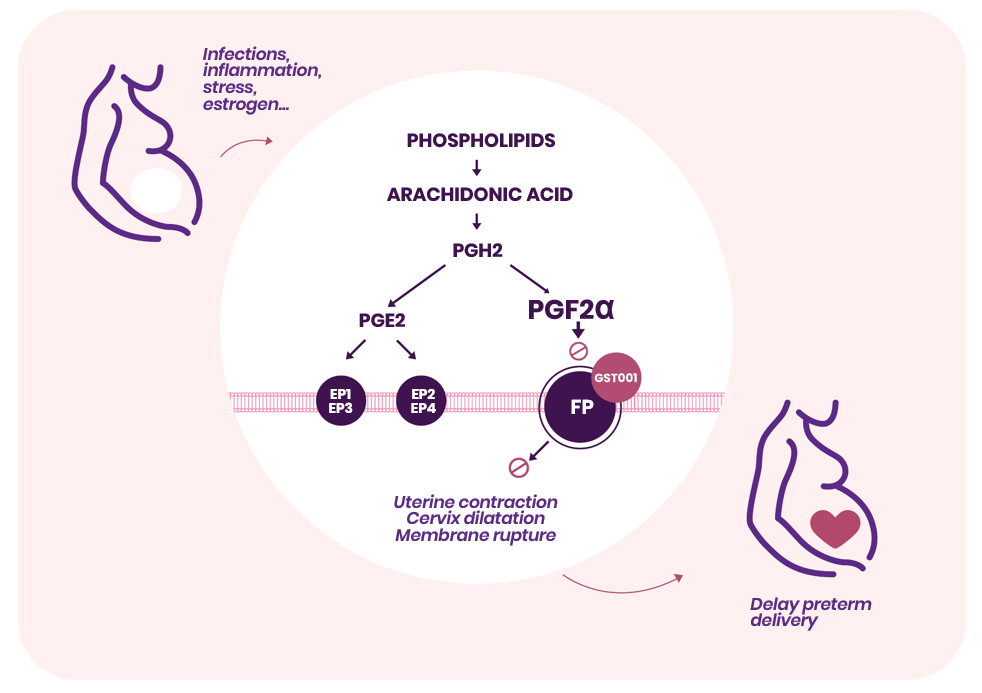
PGF2α is a key mediator of uterine activation and labor. Through the FP receptor, it contributes to uterine contractility and pro-labor signaling.
GST001 is designed to selectively block this pathway, offering a targeted approach to the management of acute preterm labor.
Gesthera is developing GST001 for the treatment of acute spontaneous preterm labor before 32 weeks of gestation.
GST001 has demonstrated clinical proof of concept in a Phase 2a study, with the strongest efficacy signal observed at earlier gestational ages, and is now progressing toward a Phase 2 monotherapy study versus nifedipine. Through this development program, Gesthera aims to evaluate whether targeted FP receptor inhibition can help move beyond the conventional 48-hour paradigm of tocolytic therapy.
Most tocolytic approaches primarily aim to reduce uterine contractions.
GST001 takes a different approach.
1 — Beyond suppressing contractions
GST001 selectively targets the PGF2α/FP pathway, a key component of the processes involved in uterine activation, labor progression, and pro-labor signaling.
By targeting this pathway, GST001 is designed to address an important component of the biology underlying preterm labor, rather than focusing solely on the final contractile response.
2 — Selective within the prostaglandin pathway
NSAIDs act upstream by inhibiting cyclooxygenase enzymes and broadly reducing the synthesis of multiple prostaglandins.
GST001 acts differently. It selectively blocks the FP receptor, targeting PGF2α signaling while avoiding broad suppression of prostaglandin synthesis.
This selective approach may offer a differentiated way to modulate labor-related signaling while preserving other prostaglandin pathways that play important physiological roles during pregnancy.

reduction
in delivery within 48h
in earlier GA
reduction
in delivery within 7 days
in earlier GA
in delivery within 7 days in earlier GA
GST001 has progressed from preclinical and Phase 1 development to clinical proof of concept in a Phase 2a study.
The study evaluated GST001 as an add-on to background atosiban therapy in women experiencing acute preterm labor.
The strongest efficacy signal was observed at earlier gestational ages.
In this population, GST001 was associated with:
60% reduction in the risk of delivery within 48 hours, and
38% reduction in the risk of delivery within 7 days.
Across all gestational ages, the corresponding reductions were 53% and 13%.
The Phase 2a program also provided supportive safety and tolerability data and demonstrated the feasibility of recruiting patients in the acute obstetric setting.
These results provide the foundation for the next stage of development: evaluating GST001 as a monotherapy against nifedipine in acute preterm labor before 32 weeks.
Preterm labor is biologically heterogeneous, and no single mechanism explains every case. However, inflammatory and pro-labor pathways appear to play an important role in spontaneous preterm birth, particularly at earlier gestational ages. At the same time, the consequences of very early delivery can be especially serious, making additional time in utero valuable.
GST001’s development focus brings together three elements:
HIGH UNMET NEED
Very early delivery can have profound consequences for the developing baby, and treatment options remain limited.
BIOLOGICAL RATIONALE
Inflammatory and pro-labor signaling provide a rationale for targeting the PGF2α/FP pathway.
CLINICAL SIGNAL
The strongest efficacy signal observed in the Phase 2a program was seen at earlier gestational ages.
Together, these considerations support the focused development of GST001 in acute spontaneous preterm labor before 32 weeks of gestation.

GST001 enters its next stage of development supported by clinical proof-of-concept data, a favorable safety and tolerability profile, and a demonstrated operational feasibility in acute preterm labor.
The next clinical study will evaluate GST001 as monotherapy versus nifedipine in women with acute preterm labor before 32 weeks, with topline results anticipated in 2028.
In parallel, Gesthera is advancing regulatory interactions with the FDA and pursuing orphan drug designation (ODD) opportunities in the US and EU, subject to eligibility and regulatory review.
Biology
Differentiated & selective mechanism of action
Human validation
Positive Phase 2a PoC with favorable safety profile
Clinical execution
Successful recruitment and study execution in acute PTL
Experienced team
Women’s health
development expertise
Achieve superior short-term tocolytic efficacy and safety profile.
Achieve prolongation of pregnancy beyond the conventional 48-hour
We look forward to hearing from you and exploring opportunities to advance maternal health together.